
 KO
KO


- Nearshoring brings production and sourcing closer to end markets, helping companies reduce exposure to long-distance logistics and improve supply chain responsiveness
- As regional production networks expand across markets such as Mexico, Poland, and Hungary, global trading organizations can play an important role in connecting sourcing, logistics, infrastructure, and market requirements
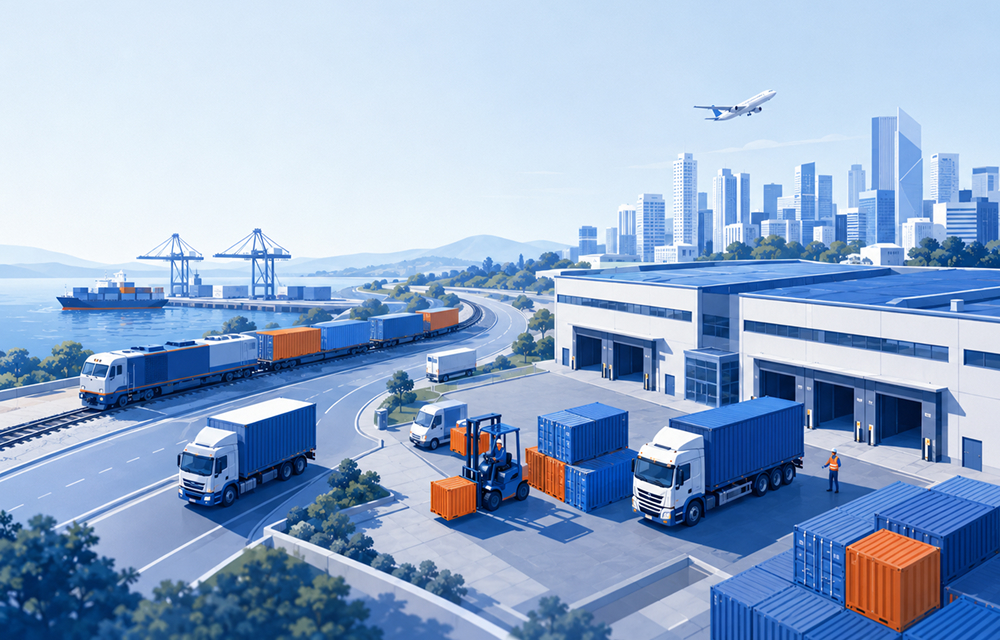
Global supply chains have expanded across countries and regions for decades, allowing companies to access specialized production capabilities, competitive costs, and global markets. At the same time, increasingly interconnected production networks have created greater exposure to disruptions that can affect the movement of materials and goods across long distances.
Geopolitical tensions, changing trade policies, logistics disruptions, and growing concerns over concentrated supply networks are now influencing how companies structure production and sourcing. Rather than signaling an end to globalization, recent OECD analysis suggests that global value chains are being reconfigured, with companies adjusting sourcing and production networks while remaining internationally connected.
Against this backdrop, nearshoring has gained attention as one strategy for balancing the benefits of international production with the advantages of geographic proximity.
What Is Nearshoring?
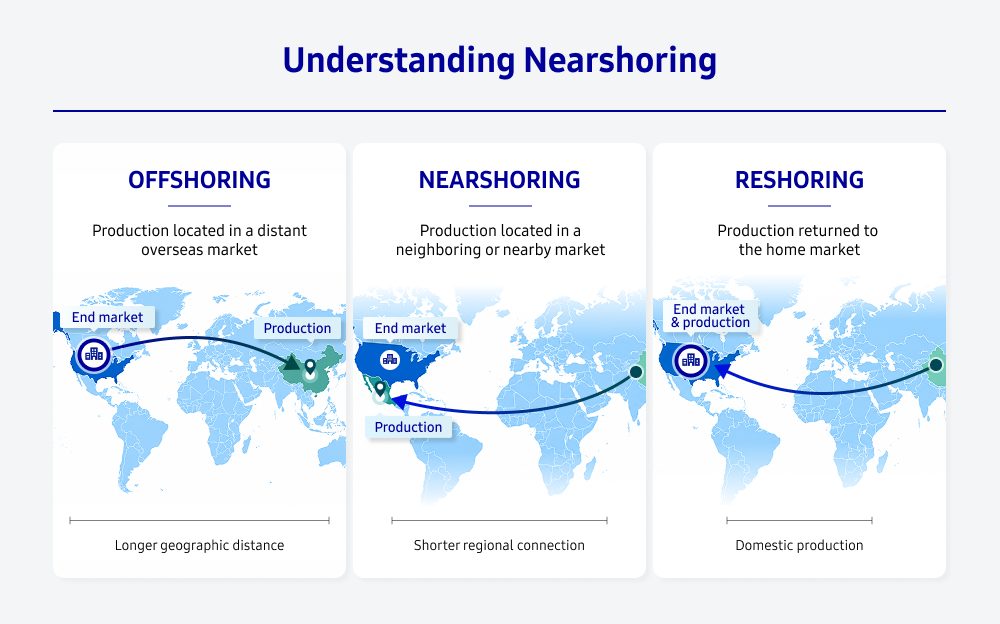
Nearshoring refers to relocating or developing production and sourcing operations in countries geographically closer to the final market. Unlike reshoring, which moves production back to a company’s home country, nearshoring maintains international production while reducing the physical distance between production locations and major customers or markets.
The approach also differs from traditional offshoring, where production may be located farther from the end market to access lower costs, manufacturing capabilities, or other competitive advantages. Nearshoring places greater emphasis on proximity, allowing companies to consider transportation time, logistics exposure, and responsiveness alongside production costs. OECD research notes that nearshoring can help reduce delays associated with long supply chains, although the feasibility and economic benefits vary across products and industries.
In other words, nearshoring is less about relocating a production site itself than about redesigning the entire supply network built around it.
Recent industrial and economic security policies are also placing greater attention on supply chain location and concentration. In the United States, manufacturing and domestic-content incentives introduced under the Inflation Reduction Act have encouraged investment in domestic clean energy and battery supply chains. In Europe, the Critical Raw Materials Act aims to strengthen European capacity while reducing excessive dependence on individual third-country suppliers. While these policies do not directly require nearshoring, they reflect a broader policy environment in which supply chain resilience and regional production capacity are becoming increasingly important.
Against this policy backdrop, how companies are actually relocating production becomes clear in the cases of North America and Europe.
Nearshoring in Practice: Regional Case Studies
In North America, Mexico has become increasingly important within U.S. supply chains. The two countries have long-established production networks across industries including automotive, electronics, and medical devices, supported by geographic proximity and the United States-Mexico-Canada Agreement (USMCA). Mexico was the largest source of U.S. goods imports in 2024, while bilateral goods trade continued to expand in 2025.
Mexico’s role demonstrates one of the central characteristics of nearshoring: production can remain international while operating within a more closely connected regional network. Manufacturers serving the U.S. market can combine access to Mexican production capacity with shorter transportation routes and established cross-border supply chains.
A similar pattern can be seen in Europe. Central and Eastern European markets have become increasingly significant within regional manufacturing and logistics networks. Poland’s location between Western and Eastern Europe has supported its development as a major logistics and industrial hub, while Hungary has built substantial manufacturing capacity in industries including automotive and battery technology. These markets provide production locations within closer reach of major Western European demand centers.
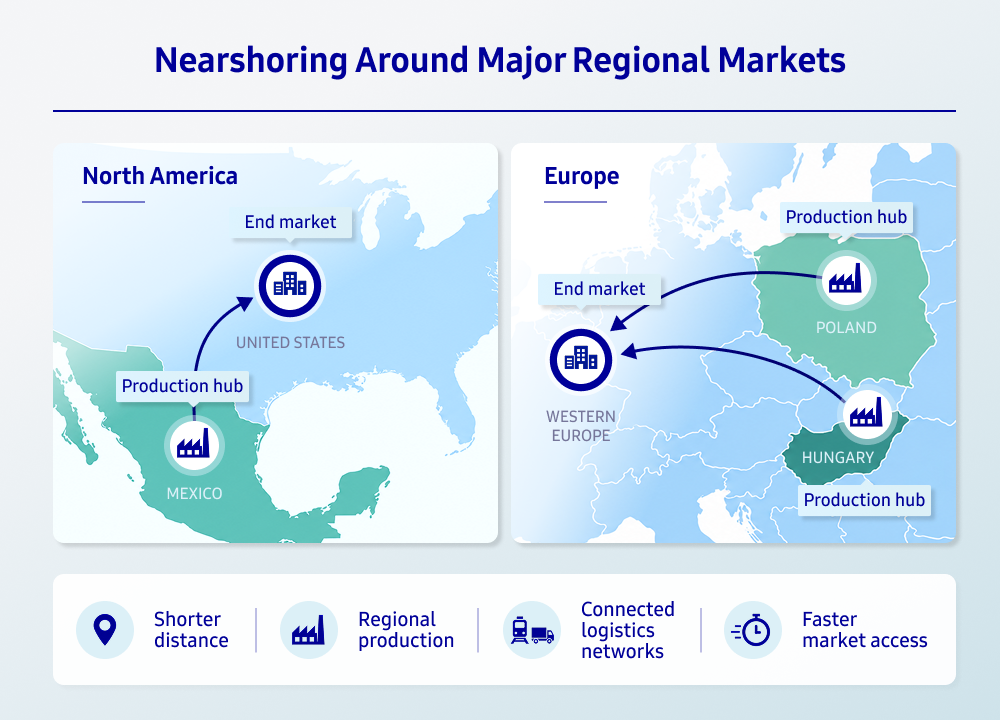
These developments do not mean that global production networks are becoming entirely regional. OECD data indicates that international supply chains remain highly interconnected even as regional linkages strengthen. Instead, nearshoring represents one way companies are adjusting the geographic balance of their supply networks.
This echoes the earlier point: globalization is not ending, but reconfiguring.
Nearshoring Is Redesign, Not Relocation
The relevance of nearshoring varies depending on the characteristics of the product and its supply chain. For businesses managing industrial materials and components, physical distance can influence transportation costs, delivery schedules, inventory requirements, and exposure to logistics disruptions.
This can make proximity particularly relevant for supply chains involving products such as steel, chemicals, and automotive components, where materials may move in significant volumes or form part of continuous manufacturing operations. Automotive supply chains, for example, often involve closely coordinated flows of components between suppliers and production facilities. Recent OECD analysis has also identified motor vehicles as one sector in which companies have adjusted physical supply chains to reduce exposure to component shortages.
Nearshoring therefore involves more than selecting a new location for manufacturing. Moving or expanding production in a neighboring market can require companies to reconsider the wider network surrounding that location, including material sourcing, supplier relationships, transportation routes, warehousing, customs procedures, and local infrastructure.
The result is not simply a shorter supply chain, but a differently structured one.
Rebuilding Supply Chains Around Regional Markets
Establishing production closer to an end market creates new opportunities, but it can also require existing supply networks to be rebuilt around a different geographic center.
Alternative sources may need to be identified, suppliers evaluated, logistics routes redesigned, and regulatory requirements reviewed. Warehousing and distribution structures may also need to change as materials begin moving through different production and delivery points. Logistics providers have similarly noted that relocating or diversifying production requires companies to consider customs procedures, transport capacity, warehousing, distribution, and multimodal connections alongside the production location itself.
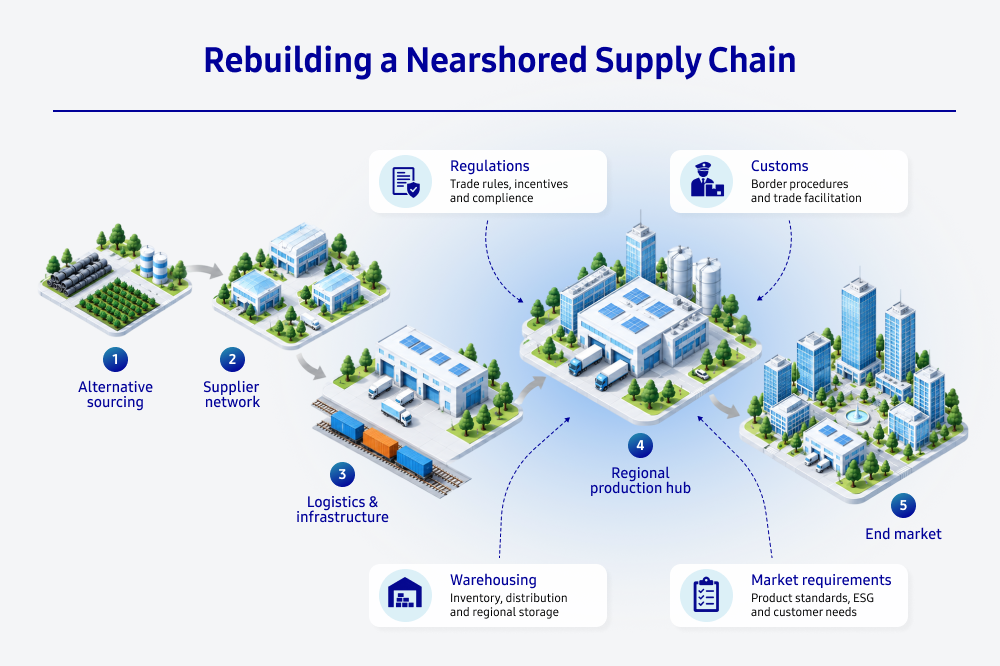
This creates an important coordinating role for global trading organizations. As regional production networks develop, trading companies can connect suppliers and materials with manufacturing locations while coordinating the logistics and market requirements needed to move goods across borders.
Samsung C&T Trading & Investment Group operates businesses across chemicals, steel, energy, and materials through its global network. In areas including industrial materials, energy, and technology, the Group also provides business solutions involving global trading, logistics services, and supply chain development.
These capabilities illustrate how the role of a trading organization can extend beyond individual transactions to connecting different parts of increasingly complex supply networks.
What Comes After Proximity?
Nearshoring reflects a broader shift in how companies evaluate global production networks. Cost remains an important factor, but geographic proximity, logistics reliability, market responsiveness, and exposure to disruption are becoming increasingly relevant considerations in supply chain planning.
At the same time, nearshoring is not a universal replacement for global sourcing. OECD research indicates that extensive relocalization can introduce significant costs and does not automatically create more resilient supply chains. For many companies, the emerging model is therefore likely to combine regional production with broader global sourcing networks rather than relying exclusively on one approach.
As global supply chains continue to evolve, proximity represents only one dimension of this restructuring. For industries shaped by technology controls, strategic materials, and economic security considerations, political and regulatory alignment can become equally important.
This is where trust — the question of who you produce with, not just how close — becomes just as important as proximity. That is where the next chapter, friend-shoring, begins.