
 KO
KO


- Airport construction brings together airside infrastructure, terminal buildings, access roads, utilities, and operational support facilities into one integrated environment
- Samsung C&T’s airport construction portfolio reflects experience across runways, terminals, baggage handling systems, support facilities, and large-scale airport infrastructure
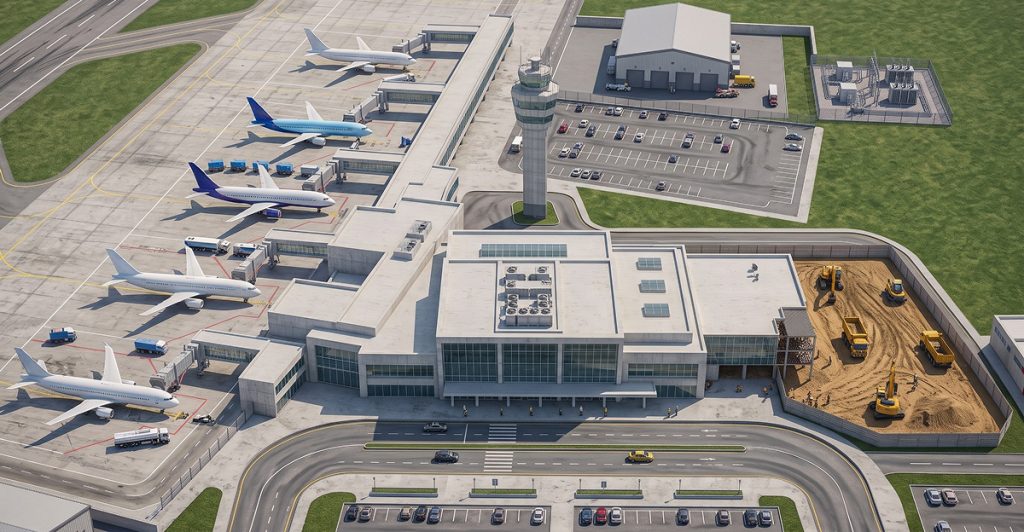
For passengers, an airport may feel like a sequence of familiar spaces: the entrance, check-in area, security screening, boarding gate, baggage claim, and exit road. From a construction perspective, however, an airport is far more than a terminal building.
Modern airports bring together many different types of infrastructure, including runways, taxiways, aprons, terminals, baggage handling systems, access roads, parking facilities, cargo terminals, fire stations, control towers, utilities, and communication systems. Each facility has its own role, but all must be planned and built as part of one functional airport environment.
This is why airport construction requires more than building individual facilities. It requires coordinated development across civil engineering, building construction, systems planning, and operational support infrastructure.
Building the Airside Foundation
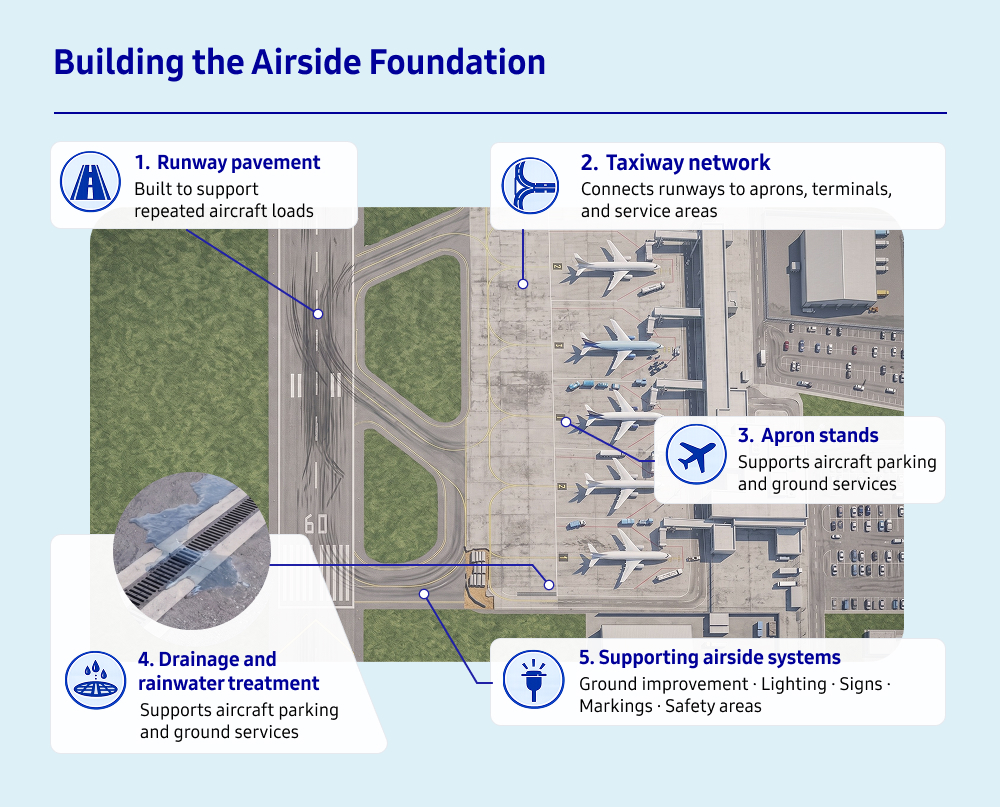
The airside area forms the technical foundation of an airport. This is where aircraft take off, land, taxi, park, load, unload, and prepare for their next journey. From a construction perspective, this area includes some of the most demanding civil engineering work within an airport project.
Runways must be designed and built to support repeated aircraft loads, changing weather conditions, and continuous operational requirements. Taxiways connect runways to aprons, terminals, hangars, and service areas, while aprons provide the space where aircraft park and receive ground services.
Airside construction also depends on supporting infrastructure that is not always visible to passengers. Pavement systems, ground improvement, drainage, lighting, signs, markings, safety areas, and rainwater treatment facilities all contribute to the performance of runways, taxiways, and aprons. Together, these elements form a larger civil infrastructure system designed to support safe aircraft operations under demanding conditions.
Building Terminal Facilities Around Function
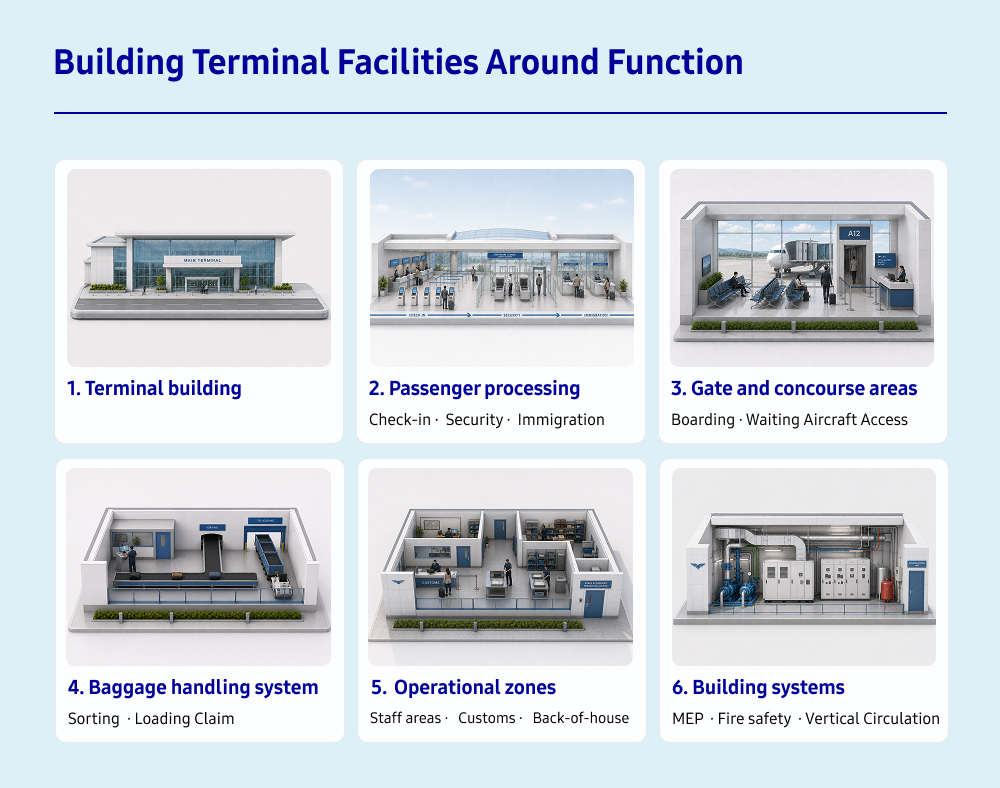
While airside infrastructure supports aircraft, the terminal organizes the passenger-facing side of the airport. It is often the most visible part of an airport, but it is also a complex building project that brings together passenger areas, equipment systems, security facilities, and operational spaces.
A modern terminal includes departure areas, arrival areas, check-in counters, security screening, immigration, customs, baggage claim, boarding gates, waiting areas, retail zones, staff areas, and building services. These spaces must be planned in relation to one another so that the terminal feels clear and accessible to passengers while supporting the systems working behind the scenes.
This makes terminal construction both architectural and technical. Large open spaces, concourses, gate areas, baggage handling systems, mechanical and electrical systems, fire safety systems, vertical circulation, and security facilities must all be integrated into the building. The terminal must also connect smoothly with airside facilities such as aprons and boarding bridges, as well as landside facilities such as roads, parking, and public transport access.
Building Infrastructure Beyond the Terminal
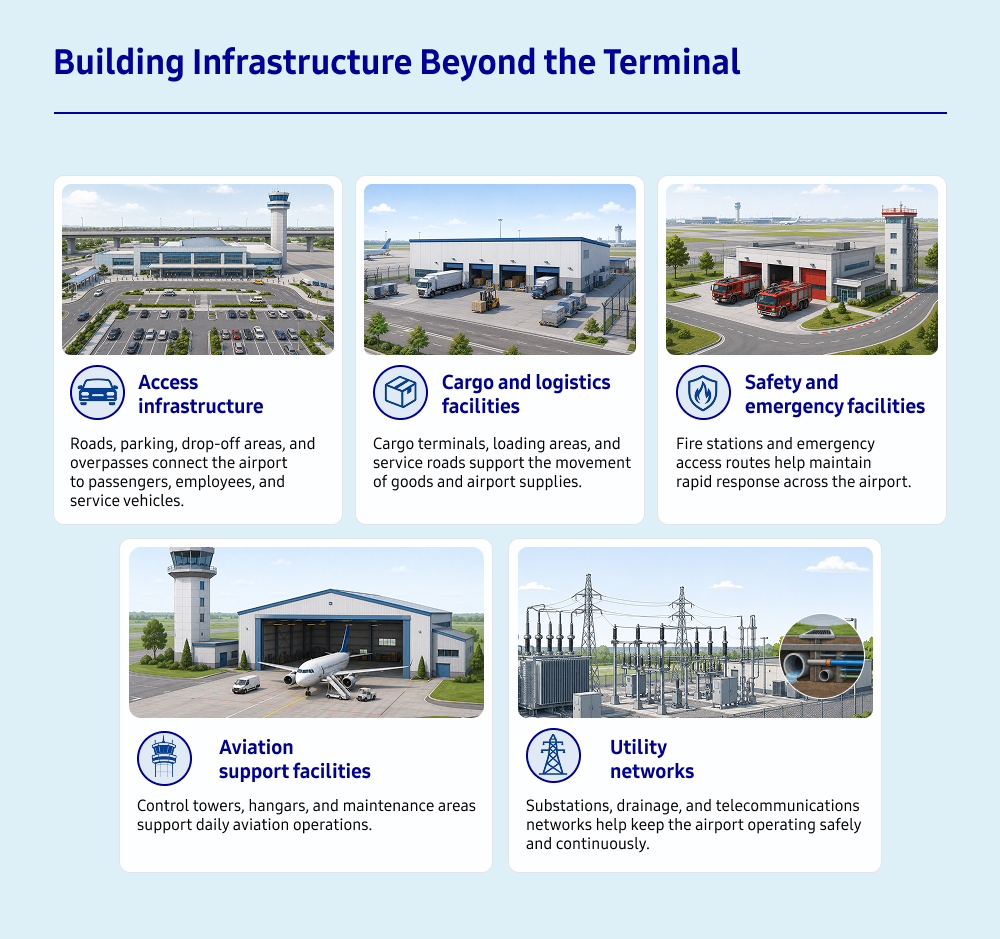
Airport construction does not stop at the terminal or runway. A complete airport also requires access infrastructure, operational support buildings, utilities, and safety facilities that allow the airport to function every day.
Roads, parking areas, drop-off zones, overpasses, pedestrian routes, and public transport connections shape how passengers, employees, service vehicles, and logistics operators enter and move around the airport. At the same time, cargo terminals, fire stations, control towers, hangars, maintenance areas, substations, utility networks, telecommunications, drainage systems, and other service facilities support daily airport operations.
These facilities may not be the first things passengers notice, but they are essential to airport continuity. They allow the airport to support not only travel, but also logistics, safety, maintenance, and operational resilience.
Samsung C&T’s airport portfolio: building connected infrastructure across global projects
Samsung C&T’s Engineering & Construction (E&C) Group has participated in airport projects across multiple regions, reflecting experience in the construction of terminals, airside infrastructure, support facilities, and large-scale airport systems.
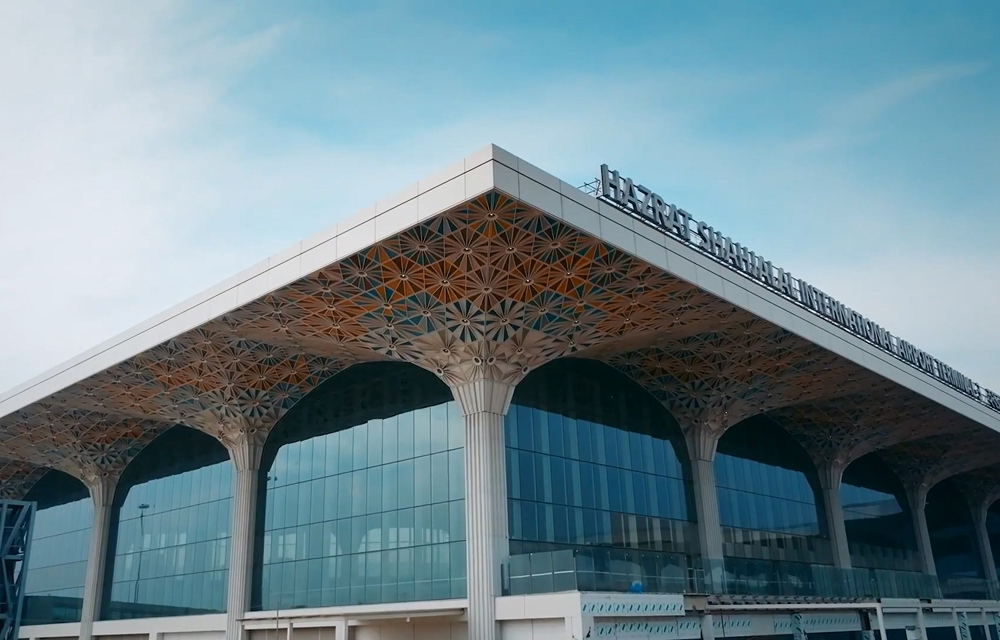
The expansion of Bangladesh’s Dhaka International Airport shows how multiple airport systems can be delivered together within one major project. The project includes Terminal 3, a baggage handling system, runway and taxiway paving, a parking lot, overpasses, a cargo terminal, a fire station, ground improvement, pavement, rainwater treatment, and related infrastructure. With a total floor area of 367,684 square meters, the project is designed to accommodate 16 million passengers a year.
The Group’s work on the Taiwan Taoyuan International Airport Terminal 3 project demonstrates its capability in delivering mega-scale terminal infrastructure. The project includes a 580,000-square-meter terminal designed to accommodate 45 million passengers per year, with mega columns enabling a 54-meter by 72-meter large-span space. Samsung C&T E&C Group also applied automated column welding, automated rebar fabrication, and a Rail Platform System to improve work efficiency and support schedule certainty.
In Mongolia, the New Ulaanbaatar International Airport Construction Project shows a broader airport development scope. Samsung C&T E&C Group carried out work across key facilities and systems, including the passenger terminal, control tower, fire station, substations, support buildings, civil works, airport special equipment, IT and security systems, utilities, and air navigation systems.
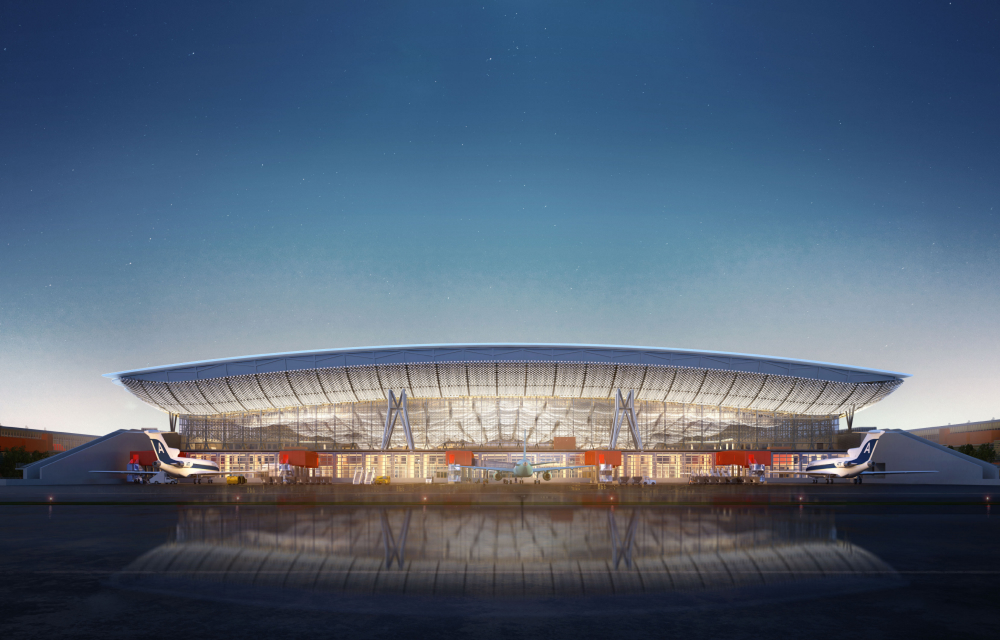
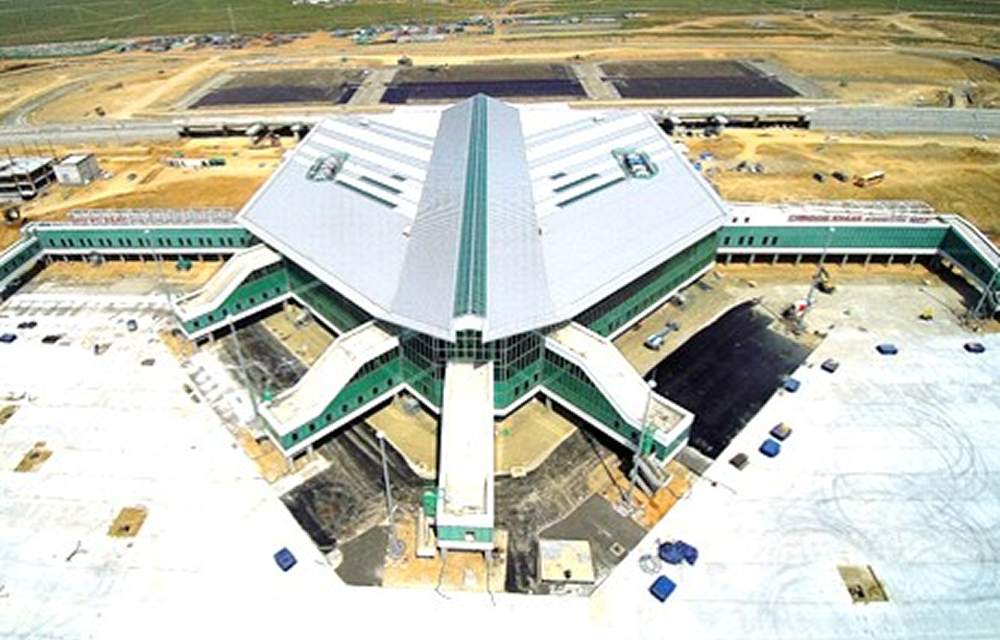
The Group has also contributed to major airport projects including Incheon International Airport, Hong Kong Chek Lap Kok International Airport, and Singapore Changi International Airport. Together, these projects reflect the broad construction scope behind modern airport infrastructure, from airside and terminal works to support facilities and operational systems.
Building the systems behind global travel
Airports connect people, goods, cities, and economies, but that connectivity depends on physical infrastructure. Their construction requires many systems to be planned, built, and connected as one operating environment.
As airports continue to expand and adapt to changing passenger and cargo demand, integrated construction will remain essential to safe and reliable airport operations. Through its experience in airport construction, Samsung C&T E&C Group continues to contribute to infrastructure that supports global travel and logistics.