
 KO


- Friend-shoring reorganizes production and sourcing around trusted economic and political partners, making strategic alignment an increasingly important consideration alongside cost and geographic distance
- As semiconductors, advanced computing, batteries, and critical materials become more closely shaped by economic security policies, global trading organizations can play an important role in coordinating materials, suppliers, logistics, and market requirements across trusted markets
Global supply chains have traditionally been structured around production costs, manufacturing capabilities, material access, and logistics efficiency, allowing companies to source specialized products from a wide range of markets.
Today, supply chain decisions are also shaped by geopolitical competition, technology restrictions, and economic security concerns, with governments and companies paying closer attention to the political and regulatory environment surrounding production and trade, not just where it takes place.
This shift has brought growing attention to friend-shoring: relocating or developing production and sourcing networks across countries that maintain relatively stable political, economic, or strategic relationships. Recent OECD analysis describes friend-shoring as encouraging production or sourcing in political and economic partner countries to reduce geopolitical exposure and maintain access to critical goods.
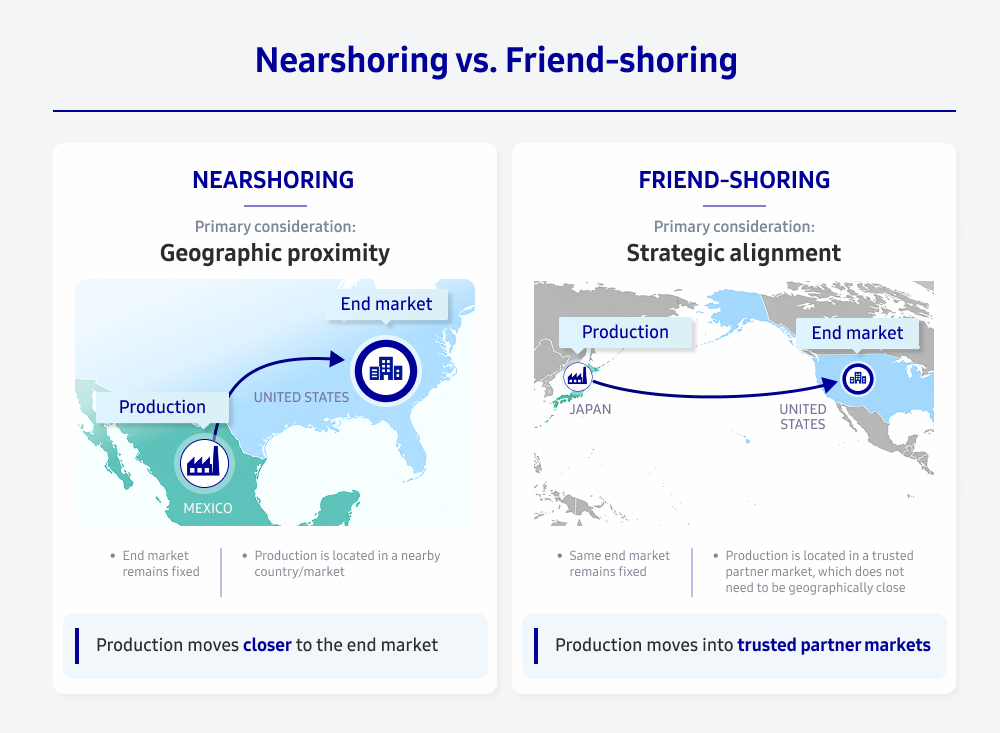
The first chapter of this series looked at nearshoring, where proximity to the end market is the defining factor. Friend-shoring shifts that axis toward the reliability of a partner country’s political, economic, and regulatory relationship.
What Is Friend-shoring?
Unlike nearshoring, geographic distance is not the defining factor. A production location thousands of kilometers from the final market can still be part of a friend-shored supply chain if it operates within a trusted trade and regulatory relationship. The distinction is one of priorities: nearshoring emphasizes proximity to the end market, while friend-shoring emphasizes the reliability and strategic alignment of supply chain partners.
The concept gained prominence as governments sought to preserve the benefits of international trade while reducing exposure to geopolitical concentration, framing it as deeper integration across trusted countries rather than a withdrawal from trade.
Technology and economic security policies have reinforced this shift. The U.S. CHIPS Act guardrails limit semiconductor capacity expansion and technology licensing involving countries of concern, while the U.S. Department of Commerce has emphasized coordination with international partners to strengthen semiconductor supply chains.
Rather than requiring exclusive sourcing from allied countries, these measures illustrate a broader change: strategic technologies are increasingly shaped by where production takes place, where materials originate, and which regulatory regimes govern their movement.
Friend-shoring in Practice: Strategic Technology Networks
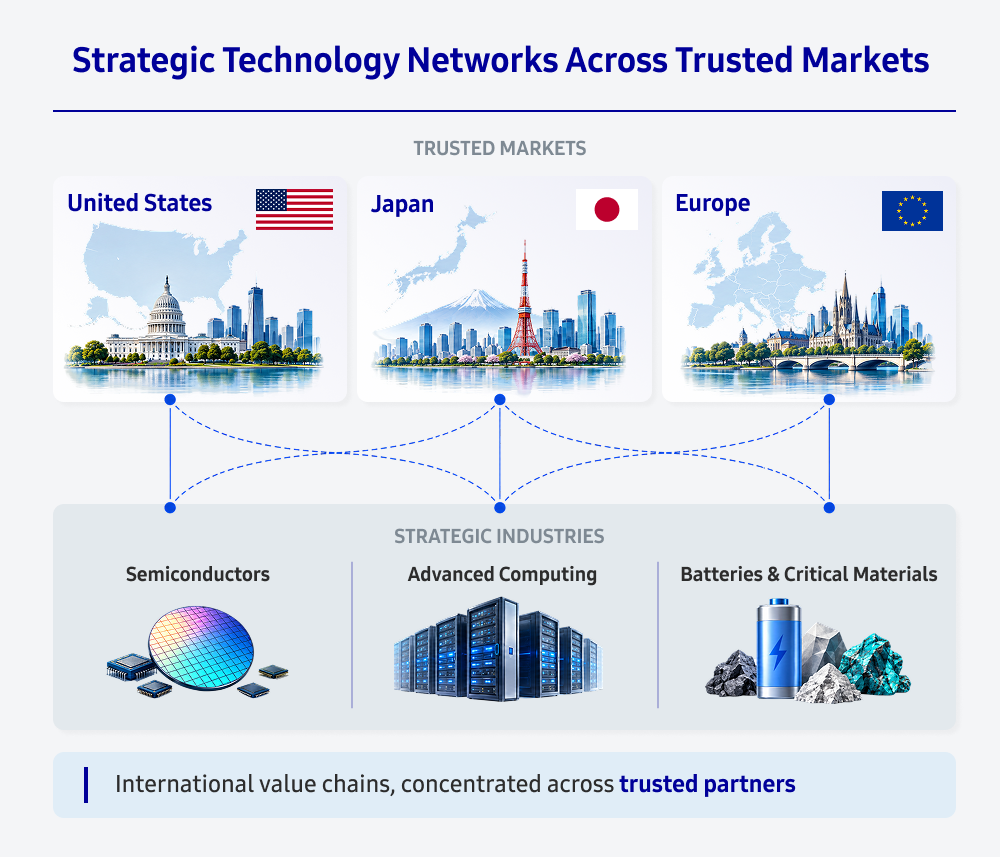
The effects are particularly visible across strategic technology industries, where production networks combine specialized materials, equipment, manufacturing capabilities, and intellectual property across multiple countries.
Semiconductors are one of the clearest examples. The United States has introduced incentives for domestic manufacturing while restricting certain investment and technology cooperation with countries of concern, Japan has expanded support for advanced production and AI-related infrastructure, while the European Chips Act aims to strengthen capacity and reduce strategic dependencies. Together, these policies reflect growing efforts across the United States, Japan, and Europe to secure strategic technology capabilities while maintaining international cooperation.
Similar dynamics appear in battery supply chains, which depend on materials such as lithium, cobalt, nickel, and graphite. The United States and Japan, for example, established a Critical Minerals Agreement to diversify electric vehicle battery mineral supply chains, while the European Union’s Critical Raw Materials Act combines capacity-building with partnerships for reliable international supply. Advanced computing is also increasingly shaped by economic security policy, with U.S. export controls continuing to restrict certain advanced computing chips and semiconductor technologies critical to AI infrastructure.
Beyond Cost and Capacity in Global Sourcing
Friend-shoring changes the criteria companies may need to consider when selecting suppliers and production locations.
Cost, quality, and production capacity remain important, but strategic industries may also need to account for export controls, investment restrictions, material origin requirements, and technology-transfer rules. A commercially competitive supplier may therefore still face regulatory restrictions in a particular market or technology. Friend-shoring decisions can also vary significantly by context, with suitable countries and suppliers depending on the industry, technology, policy framework, and final market.
For companies operating across complex technology value chains, the result can be a more selective supply network, while adding new layers of coordination. Materials, components, equipment, and final production may each originate in a different partner market. The challenge, therefore, is keeping every stage of the value chain commercially viable, operationally connected, and compliant with relevant regulations.
Coordinating Value Chains Across Trusted Markets
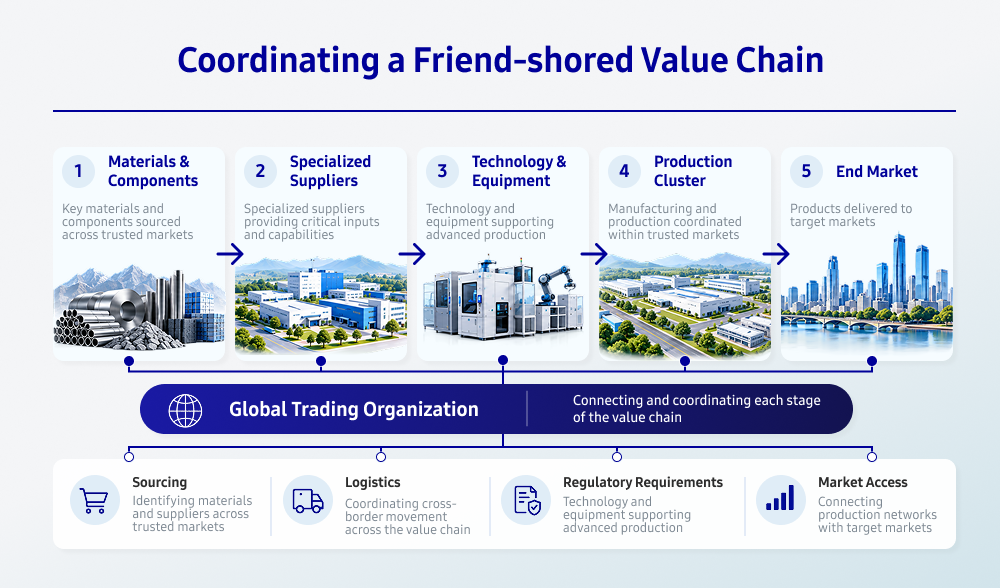
As friend-shoring reshapes sourcing and production decisions, coordination becomes increasingly important across materials, logistics, and market requirements.
Companies may need to identify alternative suppliers, verify material origins, coordinate cross-border logistics, and respond to changing regulatory requirements. For strategic products, these decisions can span multiple stages of the value chain rather than a single transaction.
This creates a natural role for global trading organizations as value-chain coordinators, extending from identifying materials and suppliers to connecting production partners, logistics networks, and end markets across regulatory environments.
Samsung C&T Trading & Investment Group operates businesses across chemicals, steel, energy, and materials through its global network and also trades technology products including semiconductors. Its Tech Division, for example, supplies specialized components used in semiconductor facilities and has expanded its operations across multiple global semiconductor markets.
These activities illustrate how global trading organizations can operate across multiple stages and locations within increasingly specialized value chains, as sourcing and production networks become more sensitive to regulatory and geopolitical conditions.
What Comes After Trust?
Friend-shoring reflects another dimension of global supply chain reconfiguration. Nearshoring responds primarily to geographic distance and logistics exposure, while friend-shoring places greater emphasis on geopolitical risk, regulatory compatibility, and trusted economic relationships.
Friend-shoring can also introduce new trade-offs. Restricting trade to a narrower group of partners can reduce supplier options and increase adjustment costs. IMF analysis has found that large-scale friend-shoring scenarios can carry meaningful long-term costs when geopolitical divisions significantly reduce trade between major economies. For many companies, the challenge is therefore to strengthen trusted relationships while avoiding a new form of concentration risk.
Supply chains built around reliable partners can still remain vulnerable when production depends too heavily on a limited number of locations. This leads to the next question: how can companies distribute production across multiple markets and reduce dependence on a single primary base?
That is where the next chapter, multi-shoring, begins.