

 KO


- Multi-shoring distributes production and supplier locations across multiple countries or regions, helping companies reduce dependence on a single market and respond more flexibly to disruption
- As production networks expand across multiple hubs, global trading organizations can help coordinate sourcing, logistics, inventory visibility, and market requirements across increasingly distributed supply chains

The geography of production is becoming more distributed as companies reassess how much capacity and sourcing should remain concentrated in a single market. Geopolitical uncertainty, trade disruptions, and changing demand are increasing the value of maintaining alternative production locations across the network.
Recent OECD analysis also highlights rising import concentration as a source of supply chain vulnerability and emphasizes agility and adaptability as key elements of resilience.
The first two chapters of this series explored nearshoring, where geographic proximity to the end market is the defining consideration, and friend-shoring, which emphasizes trusted economic and strategic relationships. Multi-shoring turns to a different challenge: reducing dependence on any single production or sourcing location.
What Is Multi-Shoring?
Multi-shoring refers to distributing production capacity or supplier locations across multiple geographic markets. A company may operate manufacturing facilities in several countries, develop additional production bases for the same product, or maintain sourcing options across different regions.
The primary objective is diversification. A wider geographic footprint gives companies more options to adjust production, redirect orders, or use alternative supply routes when conditions change.
Geographic diversification can extend beyond production itself. OECD analysis identifies diversification as a key strategy for reducing exposure to global value chain shocks. Companies can spread risk across suppliers, production bases, and markets rather than depend heavily on a limited number of locations.
China Plus One and Broader Geographic Diversification
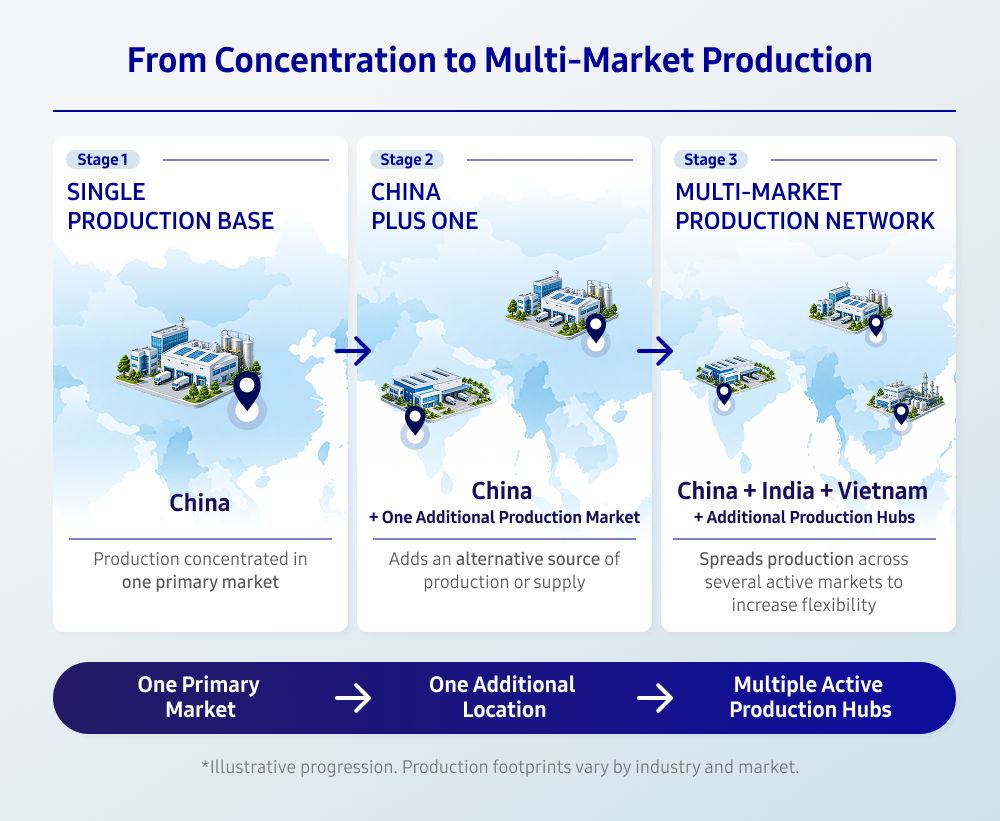
One established example of geographic diversification is the China Plus One strategy. This strategy, which emerged among Japanese companies in the early to mid-2000s, gained further prominence through the COVID-19 pandemic. In essence, it aims to reduce dependence on a single location by maintaining an existing production base in China while adding manufacturing capacity in another country.
The Asian Development Bank describes China Plus One as maintaining production in China while adding capacity in another Asian developing economy, commonly Viet Nam. World Bank analysis of Viet Nam likewise identifies the relocation of parts of value chains from China under this strategy.
The diversification trend is now broader than a single additional location. The Asian Development Bank describes Asian production networks as becoming more diversified, multi-hub, and risk-aware as geopolitical tensions and trade measures reshape supply chains.
China Plus One illustrates this diversification logic, while multi-shoring extends it across a wider network of production or sourcing locations. Existing hubs can remain important as additional capacity is added elsewhere.
Multi-Shoring in Practice: Distributed Production Networks
Multi-shoring is particularly relevant to industries with high production volumes, fast-changing demand, or geographically concentrated manufacturing networks. Electronics, electric mobility, and batteries illustrate how companies are adding production options across Asia and other markets.
- Viet Nam has become increasingly important in electronics and machinery value chains. World Bank research highlights its growing role in export-oriented manufacturing while remaining connected to imported components and wider regional production networks.
- Electric mobility shows a similar pattern. According to the International Energy Agency, Southeast Asia has become the primary location for Chinese carmakers’ overseas vehicle assembly capacity, with Thailand and Indonesia accounting for significant shares of that footprint in 2025. Manufacturers are also expanding local production to serve domestic and export markets.
- Battery supply chains are also developing additional production options. The IEA identifies Korea, Japan, Indonesia, Europe, and the United States among markets contributing to diversification across different stages of battery and battery-material manufacturing, while significant concentration remains in China.
The same principle applies where global value chain integration coincides with geographic concentration. OECD analysis highlights automotive and ICT as sectors where diversification can form part of resilience planning when the operating structure allows it.
Multi-shoring can therefore involve duplicating manufacturing capabilities across regions or distributing different production stages among specialized locations.
Balancing Capacity Across Multiple Markets
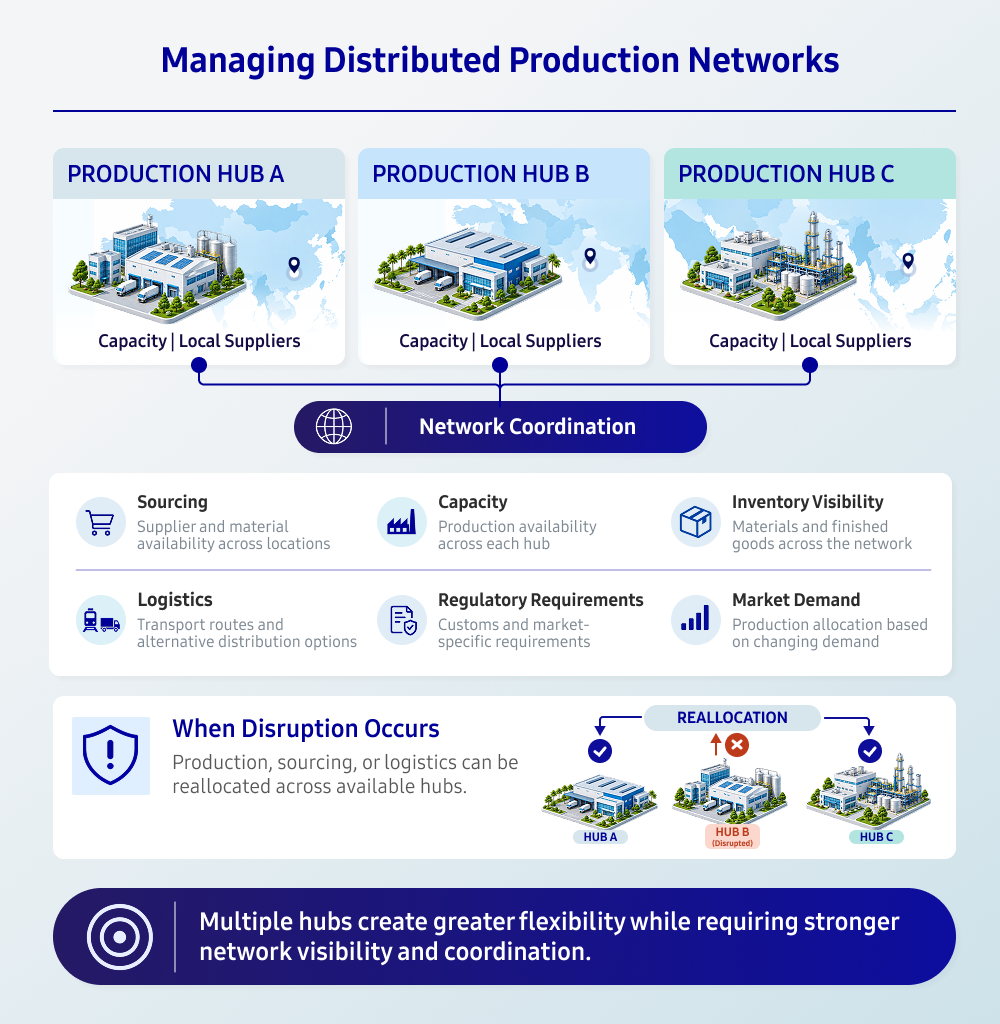
A broader production footprint creates more operating options and more flows to manage. Each hub can involve different suppliers, logistics infrastructure, customs requirements, regulations, lead times, and capacity constraints.
Companies therefore need visibility across locations so they can monitor capacity and inventory, adjust production volumes, coordinate alternative routes, and respond to changing demand.
Logistics networks may also require alternatives. UN Trade and Development (UNCTAD) recommends diversifying shipping routes, ports, and transport modes to reduce dependence on major chokepoints and maintain continuity during disruption.
This creates an important coordinating role for global trading organizations, which can connect sourcing, production locations, logistics, and end markets across different operating environments.
Samsung C&T Trading & Investment Group expands its business across industrial materials, energy, and tech through its global network. The Group also works across supply chains, logistics, customs procedures, suppliers, and customers in different countries. With over 70 overseas locations, it sources and supplies materials and solutions across regions, backed by a global network and logistics infrastructure.
As production bases spread across more markets, matching the materials and volumes each location needs through sourcing and logistics becomes a larger part of that work. These capabilities illustrate how trading organizations can coordinate increasingly distributed production and supply networks.
Building Resilience Through Diversification
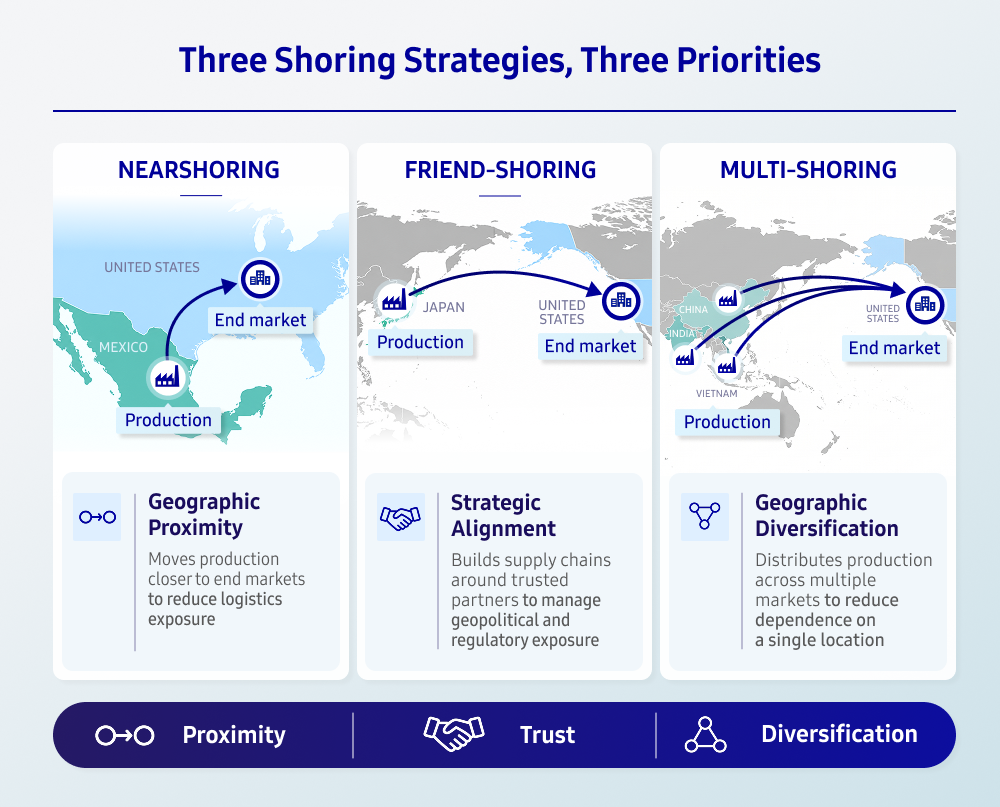
Multi-shoring completes the Shoring Trilogy by adding geographic diversification to the strategies explored throughout the series. Nearshoring brings production closer to end markets, friend-shoring organizes supply chains around trusted partners, and multi-shoring spreads production across several markets to reduce concentration risk.
Diversification also increases coordination requirements. Additional facilities, suppliers, routes, and regulatory environments can add cost and complexity, so the appropriate geographic footprint will differ by industry, product, existing network, and risk profile.
The challenge is to create enough flexibility to respond when conditions change while keeping a distributed network efficient and manageable.
Together, the three strategies show how supply chain resilience can be strengthened through a balance of proximity, trusted partnerships, and geographic diversification.